Showing posts with label solar. Show all posts

2024-05-30

Hot tubs are expensive (again)

Yes, my hot tub is expensive.

Our whole house total power consumption was, typically, 55 to 60 kWh per day. Which is a lot. I have some excuses, servers in the loft, air-con for heating and cooling in various ways, and, of course, the hot tub.

The average hot tub usage 20kWh per day.

Simple change

The simple change anyone can do is insulations. The hot tub bucket has some foam coating stuff to insulate, but there are a lot of pipes connecting and holding (hot) water. These are inside some simple panels, and are not insulated.

The first surprise was how much difference the panels make. They are just thin fibre board of some sort, not obviously designed to insulate.

This is previous normal hot tub power profile :-

As you see, it is high when heating in the morning after being off all night, and when in use, but when idle is around 25% duty cycle maybe.

We removed the panels (to help turn it around, and ready for installing a heat pump). This was a surprising difference :-

The duty cycle, when not in use, when idle, was more like 75% or more. I emptied and refilled the tub from cold and it took 24 hours of full power to get to temperature. Yes, the lid was on.

This shows the side panels make a massive difference!

You can see why!

So what is the simple fix?

Lagging, multi layered loft insulation in fact, and a lot of silver tape, and quite a few hours.

The problem is I don't know how much this has helped, but it was done on the same day as the heat pump conversion - two changes at once. But it is a cheap change and I bet it helped a lot.

I should have done this years ago!

More expensive fix

The more expensive fix is a heat pump conversion. I spent £2299 in total on heat pump and installation.

It took a few hours...


It works by sitting in line with the circulation pump and with the internal resistive heater disabled (it actually has a relay to allow it to be used if really too cold for heat pump to work). The heat pump then operates whenever the circulation pump is on, leaving the hot tub to control temperature as normal, thinking it is working the resistive heater.

So, what's the difference

Firstly the power usage is way lower, the total for heat pump and the circulation pump, is around 1kW. Before it was 3.5kW. The other change is the duty cycle, which was lower. But I cannot be sure how much is down to heat pump and how much is down to insulation.

One big statistic is heating from cold, after a change of water.

  • With no side panels, resistive load 24 hours at 3.5kW. So around 84kWh.
  • With side panels, resistive load, back in January, 12 hours at 3.5kW. So around 42kWh.
  • With side panels, insulation, heat pump, 6 hours at 1kW. So around 6kWh.

So what doing the bigger stats say?

Average usage for May, 43kWh/day. I am seeing examples as low as 30kWh/day though. It seems the whole exercise has saved maybe 15kWh/day. But May is disproportionate with over 102kWh of tumble drier not a normal 42kWh due to someone having a broken bathroom :-)

It also means I am now regularly making enough solar, with battery storage, to run the house on overnight charge only, and have next profit on export, even in May, even on some gloomy days!

Last week's total electricity bill was 41p.

2024-05-05

Is it spring yet?

This is more like it, but is only one day!

Most of our import (and today it is likely all of our import) was 2am to 5am at 14.71p.

Most export was during the day at 15.08p.

A lot of export, around 15kWh (54MJ) was 4pm to 7pm (actually 5:30pm to 7pm so we save some for evening) at 24.93p

Doing the sums I think...

  • Import 34.1kWh (122.8MJ), assume 14.71p, £5.02
  • Export sunshine, 26.7kWh (96.1MJ) at 15.08p, £4.02
  • Export battery, 15kWh (54MJ) at 24.93p, £3.74

Total electricity bill (excluding standing charge) -£2.74, and that left some in the battery still.

Without solar and battery? House used 31.4kWh (113MJ) and would have been mostly 24.51p, so £7.70.

If only every day was like this.

2022-10-04

Free electricity

I got solar about 6 months ago. At that time I did not have a battery or an export tariff. In fact it took about 5 months to get any sort of export arrangement because of delays in paperwork.

So back then... (June)


This meant I was getting free electricity. When the sun was shining I could decide to use something, like the hot tub, or tumble dryer, and use that sunshine, and the marginal cost of doing so was zero. I neither gained, nor lost, any money by doing so.

Of course there are caveats, if I was to use too many things or use them on a cloudy day when there was not the solar, I would be paying for the extra usage. So only free electricity up to a point. But still, it was guilt free using the hot tub, etc.

Payback time (August)

Finally I got an export tariff, albeit only 7½p/unit, which has yet to actually pay due to So Energy dragging their heels. But in principle, at that point, my excess solar was paying me 7½p/unit. This meant I no longer had free electricity. If I used the hot tub, even when sunny, it was costing me 7½p/unit. But that is really cheap so almost guilt free.

Battery time (September)

Finally I got the battery install, and that changes things a lot.

Because the battery can charge up on the excess solar and then be used to power the house, whist the battery is not full, and whilst we are not making excess solar more than 5kW, the battery takes the power.

In the morning, if there is enough sun to fill the battery as above, all of that extra sunshine can be used any time during the day and it will just delay the point the battery is full. So costs me the export (5p) that I am reducing. But once passed that, at the point the battery does not get full, any usage will simple mean the battery runs out faster and so will mean power from the grid, so cost me normal rate (currently 24p).

Of course, whether the usage in the morning is nearly free electricity (5p) or not (24p) depends on how much sunshine happens later in the day. It is Schrödinger's free electricity - you have to wait to open the box.

Some symmetry (October)

I am now on a new tariff with Octopus, the idea is they control the battery now, and use it to charge and feed in to the grid as needed. As they control it, they have taken the sensible approach of making the electricity a symmetric pricing, I pay 24p/unit but I get 24p/unit for export, so end up paying for my net usage at 24p/unit.

This means no more free electricity. Any usage at any time will cost me 24p/unit for that usage. Similarly any sunshine (up to my 6kW export limit after any battery charging) is 24p/unit benefit.

This is, at least, simple, and does not depend on how sunny the afternoon is - the cost is known, but does mean no more free electricity. All usage costs.

Battery feeding the grid in evening

Battery charging at night

Next step (when hell freezes over)

The next step gets fun. I am getting a second battery (which are like hen's teeth). When I get it I will be able to change to a night time EV tariff, charging it (and heating hot tub) in the night at something daft like 7½p/unit. Then I use battery and solar to run the house during the day.

This means all my electricity will be cheap, 7½p/unit, well, up to a limit. If I use too much, and then if there is not enough sunshine, I end up using during the day as the battery will run out. At that point I am paying more like 40p/unit.

So, once again Schrödinger's free electricity - I won't know what extra usage will cost until end of the day depending on how sunny it was, but as the battery plus cloudy solar should cover most of our normal usage, it should always be the 7½p rate. The only caveat is I may want to shut down hot tub until next day if no sunshine, and I may want to discourage tumble dryer on cloudy days.

Every little helps

Even though some of these options mean no free electricity, all of these steps reduce my overall bill, a lot. The solar now means I am paid for electricity I make at a sane rate, which is excellent. Indeed, some options could mean exporting extra battery storage at the end of the day to get paid more than it cost to get the charge in the morning. It could make some days negative total price.

Nothing is free

Don't forget, it is only free if you also forget the huge installation cost. Start here.

2022-09-07

Battery, part 3

Slightly misleading as battery is charging!
I have just been going over the final handover and testing with Green Park for the Tesla Battery.

Part of it was making a power cut. This was interesting.

So a few facts that are useful to know.

  • A real power cut means a couple of seconds of no power. It is not seamless.
  • A deliberate "off grid" (done on the app) does not, so if it is a planned power cut then you can seamlessly go off grid if needed. Good.
  • Going back on grid is seamless, a few seconds while it sorts phase match and back on. Good.
  • It will take solar during a power cut, and charge the battery if needed. Good.
  • If the solar exceeds its 5kW charging capacity it will shut down the solar (done using frequency change, apparently).

The last point is a pain as the solar can do 10kW. More importantly the solar can control what it makes by de-optimising the panels, so it if knew it was a problem it could reduce power. There seems no way to link these intelligently, sadly. But once I have a second battery we will be fine at it will match the battery, at least until the battery is full. What I don't know is if there is any way it tries to turn the solar back on in such cases, maybe trying it for a few seconds every now and then? Must find out.

And as for the first point, a power cut causing a blip - I need a very small UPS for my comms rack to last a few seconds, that is the easy part.

Second battery

One battery can handle 5kW in/out, and charge to 14kWh. This is fine for most cases for balancing the solar and usage and reducing export. It is also perfect for getting on the Octopus tariff for this where they manage the battery and I pay for net usage.

However, one battery does limit my options. It does not have capability to run the house for 24 hours, meaning that I cannot make use of "cheap charge at night and run of battery for the day". If I could, I would save even more, but without that I could be using more expensive electricity later in the day, especially in winter when less sun.

One battery is also likely to have the same issue if I went on an agile tariff, in that trying to match charge at low price and usage when high would be hard if I do not have a whole day's capacity.

So for these various reasons, a second battery is on order. For now, I am trying to sort the Octopus tariff, which is fun.

Off backup

The other work still planned is an additional small consumer unit that has a few circuits which will not be on backup. The Tesla can only do 5kW, so if I have the tumble drier on, or the car charger, it won't work. There are about 4 circuits to move to that. All good fun.

2022-09-01

Battery, part 2

Tesla Gateway 2
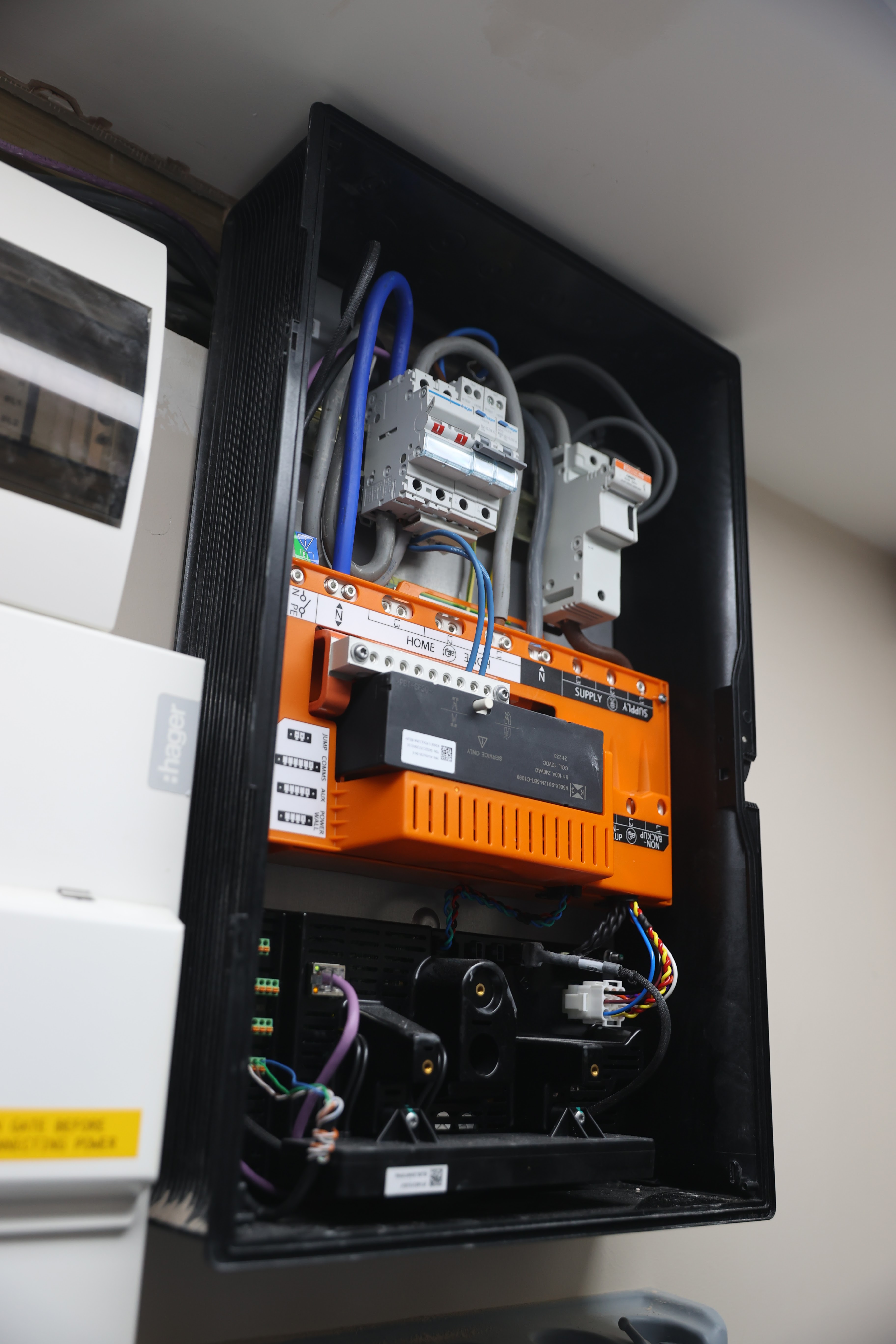
This is just about the install. I have yet to get in to the details of APIs, and apps and so on. So just the install for now.

It is all pretty simple to be honest. Battery on the wall outside, and "gateway" box inside.

The gateway is put in line from the incoming power, so the tails in to the consumer unit had to be fished out and fed in to the gateway and then new tails to the consumer unit. The battery is then connected to the gateway. There is comms to the battery, and a current clamp for the solar incoming. The unit has ethernet, but also has wifi and cellular.

I say it is simple, but fishing the tails meant eventually making holes the other side of the internal wall. The holes through the wall to the battery outside involved big drills, and eventually an endoscope I happen to have! Both tasks probably involved about an hour of "no progress". But the job was done in the day, and nicely done by Green Park Power.

It is worth explaining, this "gateway" allows me to work off-grid as well, running just from the battery. Ideally, to do this, I need to put some circuits on a separate "no-backup" circuit. I'll get a small additional consumer unit installed for that. It will have the tumble drier, hot tub, heated kitchen floor, EV charger, on it. For now, we have the whole house on battery, which will not cope if we go over 5kW during a power cut.

Right now my solar and demand have, as normal, gone up and down, but the battery has balanced it all so zero grid usage, either charging or discharging the battery. That alone is quite amazing.

Tesla app

There are a lot of settings, and I have not even started to look at them. I need to read up on this, and work out the best way to keep my power usage sensible. I also need to mess with a couple more current clamps as I no longer see the final import/export on my own monitoring, or the solar edge.

Longer term I need to work out if there is a good tariff to be on, and separately if I can use an agile tariff in a clever way. What we do have is wiring for a second battery - but that may take 6 months to get.

First gripe: Cannot work out if any way to turn of WiFi AP SSID from it!

2022-08-21

Battery, part 1

This post is literally just a teaser.

The solar install was to include a battery, but it has taken months to arrive. Finally it is fixed to the wall - that is it for part 1, bolted to the wall.

It is Tesla Powerwall with 13½kWh usable storage, with 5kW charge/discharge rate.

Later this week Some time next week, it will be wired up, including a "gateway" to allow me to run off grid during power cuts.

Should be fun, watch this space.

But yes, planning to explain what it is, how much, what it does, how the wiring works, how it works with the solar panels, the app, the API, the tariff I end up, etc...

2022-04-16

Solar install, part 3 (performance)

Read part 1 for more background.

I have now had one cloudy day, and one much more sunny day. This is April 14th and 15th. Bearing in mind that the forecast from the installer was an average of 24.28kWh/day over the year. I expect winter to be much lower, obviously.

Cloudy April day

The cloudy day had a total of 17.9kWh, usage was 47kWh.

Sunny April day

The sunny day had a total of 48.5kWh, usage was 45.4kWh. Yes, we made more than we used!

P.S. After a few days I can see we are typically doing 40kWh to 50kWh most days, the low cloudy day seems to be very much the exception.

What does that mean?

It looks very much like the forecast is, as expected, somewhat pessimistic and I can expect much higher. The 40 and 50kWh days in April suggests we will easily exceed the forecast for the year.

The sunny day is interesting - we made more from solar than we used, even in April. I can't be sure how usage will go over the summer - I expect it to drop noticeably as the heated kitchen floor used a lot in the winter, but also we now have air-con. The air-con is quite low usage at present, but when it is really hot and sunny it will be using more. The good news is those days will have more solar.

It really does highlight the need for the battery (which is on order). With a battery I could have had all of yesterday's power from solar and imported none. That is, quite frankly, amazing.

I have also changed the hot tub, as one of the really high users of power, to heat during the daytime when we have spare solar rather than maintaining temperature all day and night. Especially without the battery - that alone will save £'s a day.

Part 4

2022-04-14

Solar install, part 1

I finally have a solar install, and a battery on order. So this blog is the first one on this - I don't have a lot of data yet as it just went in, and I don't have a battery yet as they are like hen's teeth, so more on both of those later.
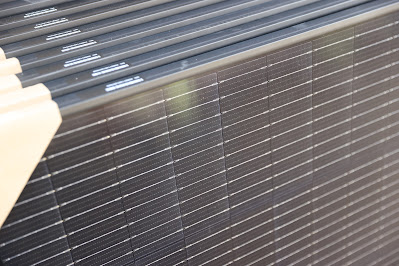
Solar panels waiting to be installed

The basics on a solar install

Firstly, it is not a simple/quick "free electricity" solution for the current price rises. There is more to it in terms of whether it is worthwhile, and over what period, and so on. I hope I can explain some of the factors here. There are several factors.
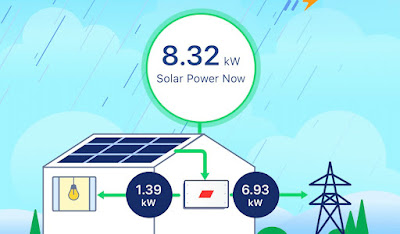
When the sun actually came out yesterday

How much power do we use anyway?

In my case we use a lot of power. Over the winter, since I have started monitoring in more detail, we have been using around 60kWh a day. One kWh (kilowatt hour) is one "unit" of electricity, and currently that is costing me over 28p - but tariffs are a key factor here. 60kWh is a lot, and a typical household is more likely to be 10kWh/day. Bear in mind that will depend on the time of year and the type of heating and so on.

One of the first things I did was install some monitoring. This is way more useful that simply having a smart meter as it tells me much more accurately where the power usage is happening. This meant some Shelly EM modules with tasmota and current clamps - not that expensive, but did mean messing with current clamps on lots of circuits. It means I can graph usage per circuit.

It immediately highlights the key uses of power here are the hot tub (yeh, it came with the house), and the heated kitchen floor (also came with the house). Other users like tumble drier come in when used, obviously, and now we have air-con that too is a noticeable factor. Some adjustments to temperature made a noticeable difference, and I really want to find something nicer for the kitchen floor (it is also a living room). The rest of the house is gas central heating. I would say that summer is expected to be lower, but the air-con will make a difference.

So yes, we are a very high user. This is, however, a factor in terms of solar - if you make more than you need you are "selling" it as export - but getting a good tariff for that is not so simple. You make/save most with solar if you are using it yourself, as that will save you money at that huge 28p/unit rate. Exporting it may only get you 5p/unit. Oddly you can have a different company for "exported" power payment than for your "imported" power - crazy, but apparently the best deals on export are when both are the same.

The other issue here is that our usage is in bursts - we have a base of around 1kW a lot of the day, but hot tub uses an extra 3kW in short bursts, and the kitchen floor is even more, but again in short bursts and often in the morning before the sun rise in winter. So we have these high bursts of usage that will often not be covered by solar. This is where the battery comes in - being able to store the extra solar when only using 1kW and power things when they burst. (more on power monitoring)
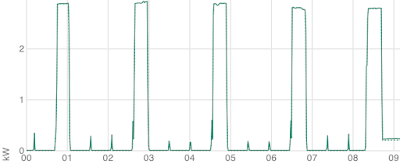
Hot tub

The good news is the air-con is not quite so bursty the way I have it set up now, and this can more easily be covered by the solar before I even have a battery.
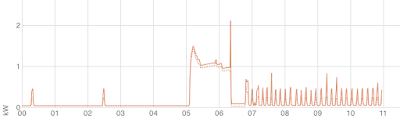
Air-con

So why solar anyway?

One obvious factor is saving money - but this is where there is a catch - if I simply put the money in a savings account and used it to reduce my electricity bill every month, that would probably be better for the next decade - well, maybe, but certainly for a few years.

This is all a bit of a "Vimes's boots" scenario - i.e. the poor have to keep buying cheap boots, but the rich can afford to spend a fortune on boots once and they last so much longer than they end up spending way less overall. The same is true here - if you can afford a solar install you can have decades of spending way less on electricity - something from which that those who cannot afford the install would greatly benefit.

So what other factors are there?

Well, one factor for me is the stability of this (or perhaps "energy security" is a better phrase) - electricity prices are silly now and could get extra silly soon (next rise is October). If I can produce a noticeable chunk of my electricity, and have a means to reduce a lot of the rest (shut down the hot tub, etc), I can protect myself from those silly prices. It is, of course, hard to pin a figure on what this means in advance, especially if trying to plan for the next decade.

Another factor comes in with the (expensive) battery (Tesla power wall). It is able to power the house, so a short power cut (of which we have only had one so far) can be covered. Again, there are risks - the way the country is being run, and factors like Russian oil/gas, etc, could mean power cuts - who knows? This is a small risk, but it would be very nice to manage small power cuts - whether deliberate ones, or simply storm related (as last time).

Finally, it is investment in the house. We expect to be here some time - maybe "forever" from our point of view, but the solar install should improve the house value. This may be useful if ever we do want to sell, or if we raise funds on the house, or even when it comes to our kids selling it. The installation is not just throwing money away - it increases the house value some (yes, this itself is complicated as some older solar "roof rental" deals are more of a burden and can reduce value).

Of course it is also an environmental aspect - it helps reduce the burning of fossil fuels. Indeed, I seem to have earned a gold star already!

Solar and/or battery?

There are two distinct aspects - solar panels and battery. These are distinct but do help each other, so you may want solar, battery, or both, depending on your circumstances.

Solar

The Solar aspect is pretty simple - the panels make power - more in summer than winter - only during the day - more when the sun is shining than in cloud. The installer can predict how much in the year. That will allow you to work out the cost vs payback. The installer should do proper forecasts.

For us, based on 22p/unit starting point, we are looking at a little over 10 years to cover the cost of the solar system install. Over the following 10 years we are looking to save a further twice the cost of the install. This assumes some inflation on electricity prices as well as some degradation on performance.

On this basis you can see solar cost per unit over 20 years is good, better than you would get from any electricity supplier even now. On a long term plan it makes sense. It may even make sense for some people on a "loan to install" basis, but that is a risk over future interest rates.

Battery

This is where the options and costs get even more complex. It seems there are some battery systems which basically help "level out" the solar some (those 3kW spikes for hot tub, etc), and are not a lot of good as a "backup" for a power cut. These are probably a no brainer in terms of managing the solar supply from any install as the usage and the solar can vary during the day - something even a small battery can level out nicely.

There are, however, some that can back up the house, and the tesla power wall is one of those. Such systems cost a lot.

For a start, the battery helps make the most of the solar. It means you are not exporting. Without this, any time in the day we are making more than we use, we are sending that electricity to the grid. It you are lucky, and have sorted the paperwork (I have not yet, just installed), you may get 5p/unit for that. It is much better for that to go in to a battery and then get used later saving you 28p/unit.

For example, right now, on a very cloudy April morning, I am making over 2kW but only using 1.43kW. As I don't yet have all the paperwork to be on any "export tariff", I am just wasting that 0.61kW going to the grid.
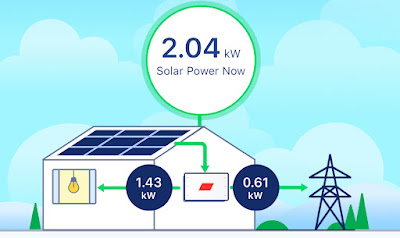
A cloudy morning

In an ideal world with solar and battery, when you have enough solar in a day to cover a day's usage, you want a battery that can store enough to cover the night time, and hence never import any electricity on those days (typically in the summer). If you have usage figures then that can be quite easy to work out. Even so, you may also be able to move usage around - especially if anything (e.g. a car) needs charging as well.

But a battery has other advantages - apart from the possibility of covering a short power cut, it can also work with agile tariffs - charging from the power grid when electricity is very cheap in the middle of the night, etc. You then use that power during the day.

Indeed, just having a battery, and no solar, can end up making your electricity very cheap. We may even want a second battery at some point for this very reason.

In this case you want a battery that can charge in the short periods of cheap power (middle of the night), at the same time as perhaps charging your car, and hold enough (allowing for any solar contribution) to power your house for the rest of the day until the next cheap charging point. Again, not too hard to work out, and to decide if you want to cover winter (less solar) and summer (less battery needed).

So for some people a battery is an option - but a good battery system like the tesla power wall can end up costing a lot more than the solar install.

There are some power companies (Octopus, for example) with special tariffs where you give them control of your battery (if a Tesla battery) allowing them to feed in power when they need, and they end up charging you only for net power usage at a much lower rate. Such a tariff is extra "simple" as you don't have to do anything - it just works and you have power at a low rate. They even keep some in reserve for power cuts.

Both

In my case, I have gone for both - though that does make it harder to work out what each separately may be saving me. It also means I need to sort some suitable tariffs. That special tariff that need control of the battery also only works if you also have a solar install and a tesla battery. Even then, there are some limits per battery on solar capacity and daytime usage, with which I may have a challenge on only one battery. This could be fun, and I am sure another blog post eventually.

Payback

The forecast payback, as I said, was a round a decade, for the solar alone, based on 22p/unit starting point.

That said, if I was to take a simple calculation of 60kWh/day usage at 28p/unit, that is £6132 a year. If I make an average of only 25kWh/day from solar, and get on a 10p/unit "they control the battery" tariff, that gets to £1277/year, saving around £4855k/year. That makes a payback of a £22k solar and battery system under 5 years. If I can make use of the battery to charge at 5p/unit middle of the night, top up with solar, and use battery for my usage, then payback would be 4 years. There is even a saving on standing charge to add to that. Now allow for inflation, or maybe an October rise to 35p/unit, and well, things get very interesting - there is a very real prospect of the whole system payback in only a few years - even Vimes would be impressed.

Of course, it could be we get a sane government, and sensible power pricing, and the payback is way longer - but I am, none the less, buying stability.

More specifics...

The supplier I have used is Green Park Power, based in Abergavenny (a short walking distance from my house). They have been very professional. I'm impressed.

The system is 31 panels, each 390W, so 12.09kW total. It is using solar edge - with per panel optimisers and an inverter in the loft. The per panel optimisers are DC/DC convertors allowing the mix of panels that have high and low light levels to all work together, even allowing for some in shade. Traditionally panels in shade can bring down the overall performance, but not so in this system.

It also allows monitoring of power per panel, and whilst there system is cloud based (which I dislike), it is very good. (I thought solar panels did not like "clouds"). I may set up some MODBUS stuff to provide some local monitoring in the long run, obviously. The inverter does connect to WiFi or, as in my case, Ethernet.

The figures in my case are roughly £12k for solar and £10 for battery, but it will very much depend on circumstances.

It really is simple

It is just working, the solar power cancels a chunk of the usage and creates some export. I mean, yes, once I have a battery, I may want to fine tune to make the best of some tariff, but in general I don't have to actually "do" anything - it just works. For now (before I get a battery) I have tweaked the settings on my hot tub, as one of the main power uses in the house, to be when the sun is shining.

But ultimately if someone bought the house they would not have to "do" anything, it would just lower their bills!

More to follow...

The solar edge monitoring if very comprehensive, and in a few days I should have some more useful data to share. Later this year I'll also have a battery to play with.

The first day, yesterday, was very gloomy, wet, and cloudy, but in the afternoon we were seeing a consistent 5kW, and at one point in the morning when the sun came out, well over 8kW. In our case, even though the system is rated to 12kW, it is 12 panels facing west and 19 facing east, so not expected to have full capacity, making 8kW rather impressive. I am going to love seeing a proper sunny day on this. But only starting stats some time yesterday, I don't even have a full (cloudy) day's stats yet.

A quick update: First whole day (all cloudy) 18kWh, second day (more sun) 43kWh so far (4:30pm). Remember the forecast was only 25kWh/day over the year, and at this rate I'll exceed that just in the summer.

Part 2

Clocks

Some time geeks (should I say Time Lords) checked out my clocks. Seems they are impressed, saying sub microsecond. I have spent all day tryi...